My Own Making
The problem
Founders often start with a solution before they can name the problem. The result is work aimed at the wrong target, found late.
What I built
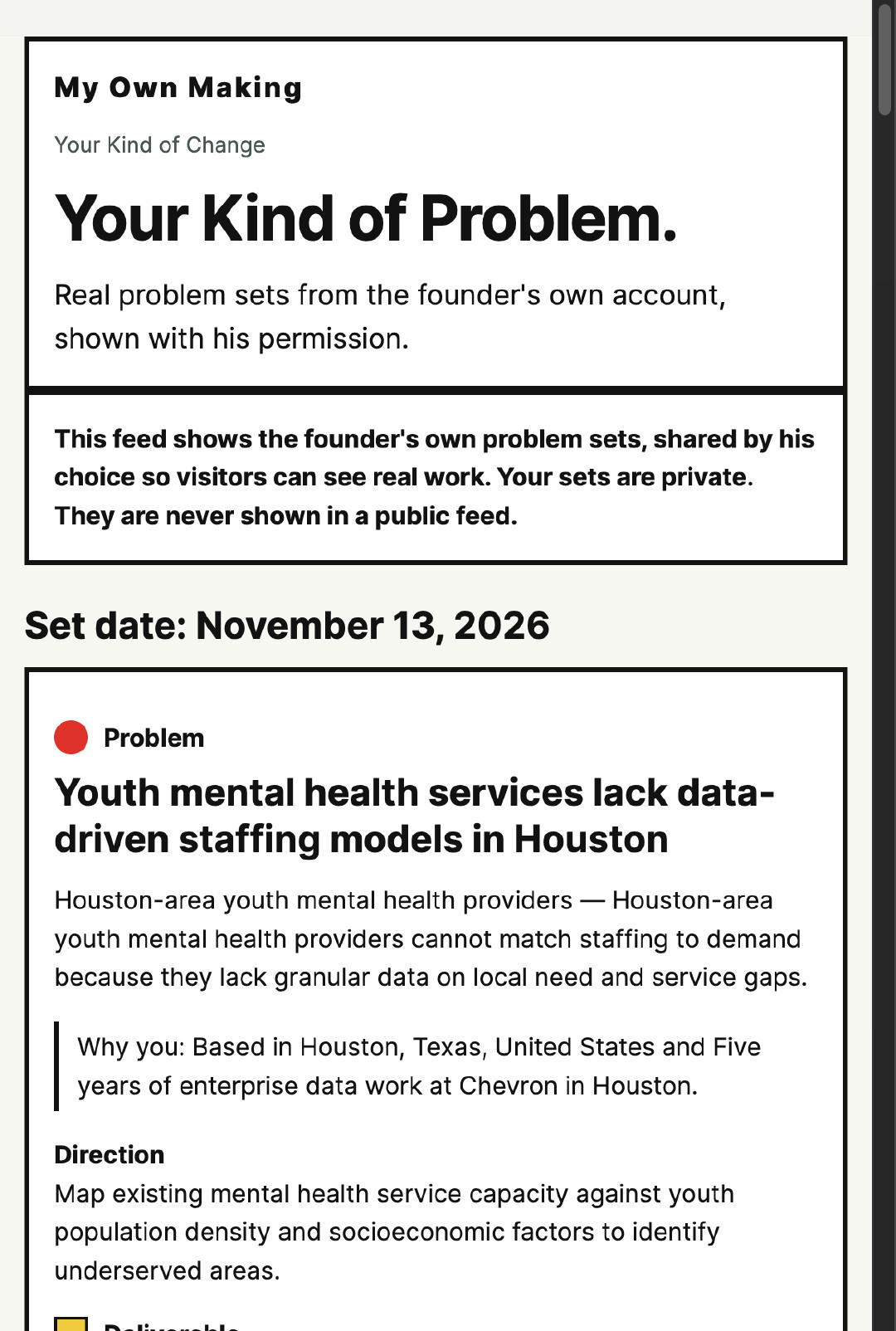
My Own Making is a problem-discovery tool. A staged AI pipeline turns a founder's own context into a structured set of problems. Each problem carries a direction, a deliverable, linked sources, and three options in set roles: one strong, one unusual, one wild. Source matching is word-based by design, not vector search.
Architecture
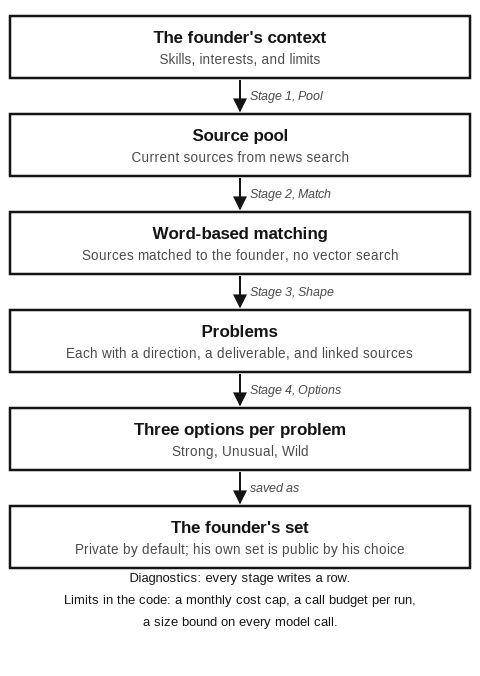
A run moves through four stages: a source pool, word-based matching, problem shaping, and options. I chose word matching over vector search so that every match can be explained in plain words. Every stage writes a diagnostics row, so a failed run names its stage and its cause instead of failing in silence. Hard limits sit in the code itself: a monthly cost cap, a call budget per run, and a size bound on every model call. A run finishes on the server even when the founder closes the page.
Design and taste
The public surfaces use a Bauhaus frame: heavy black borders, flat red, yellow, and blue, and circle, square, and triangle marks. The signed-out home page works as a living advertisement, not a login wall, and it shows real output instead of promises. Privacy is the headline design decision. My own set stands public by my choice, under a plain notice, and every other user's set stays private and out of the feed. The three option roles are also a taste choice: one strong, one unusual, and one wild option for every problem, so a set never returns three versions of the safest answer.
AI tools and my direction
Claude Code carried the design work, including the eighteen-issue redesign pass that set the pipeline, the cost limits, and the public showcase. Codex implements my designs in separate branches, and I rule on each build before it merges and publishes. I test with simulated founder walks, because I have no access to real test users, and I read the diagnostics rows before I read any summary of a run. When a stage fails, the fix is one lane with one cause, and the record of the failure stays in the diagnostics.
Stack
Node.js, a staged LLM pipeline with per-stage diagnostics, word-based source matching.
My role
I designed and directed My Own Making. It was built with agentic coding tools under my direction: architecture, sequencing, and acceptance were mine.